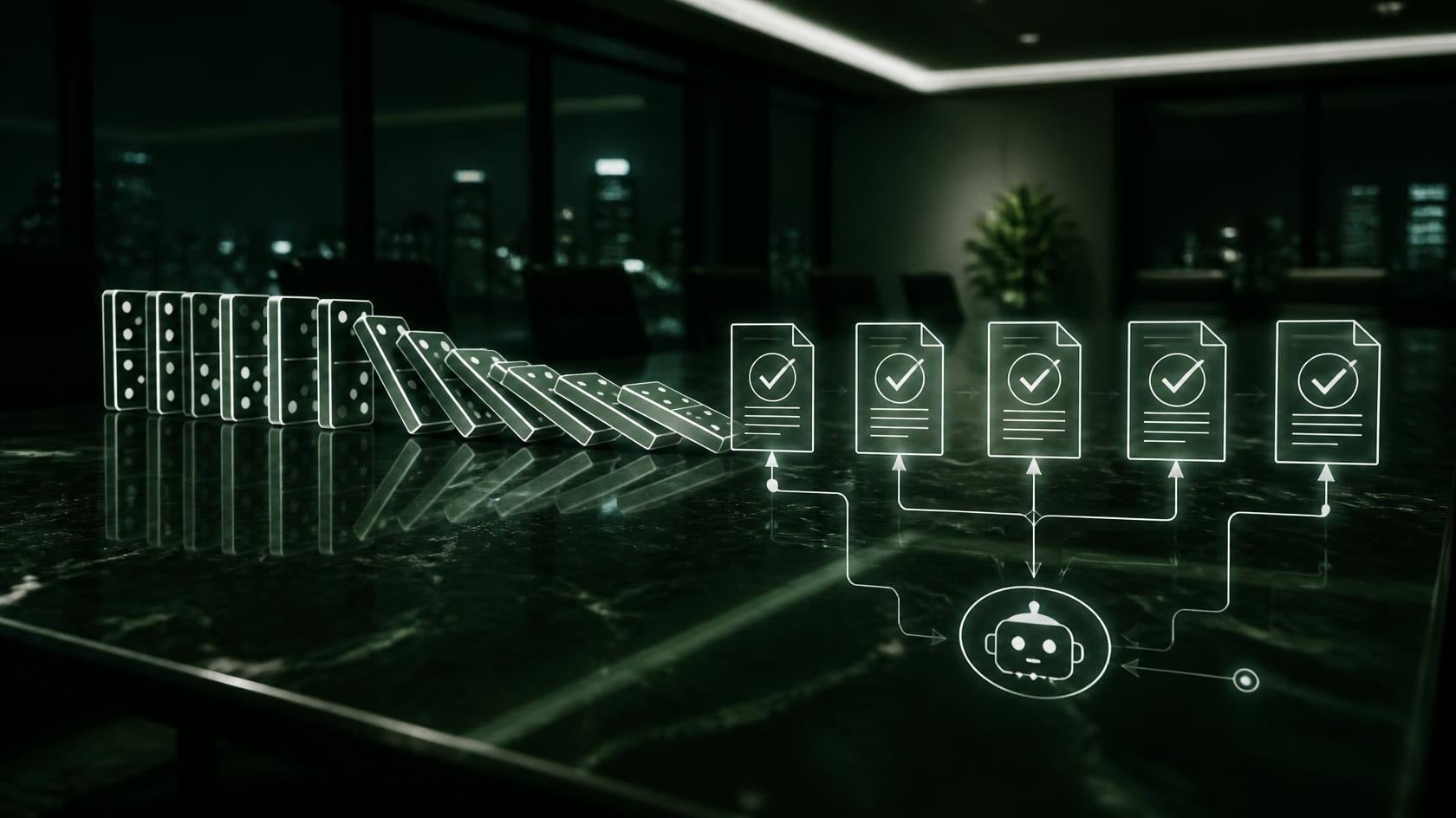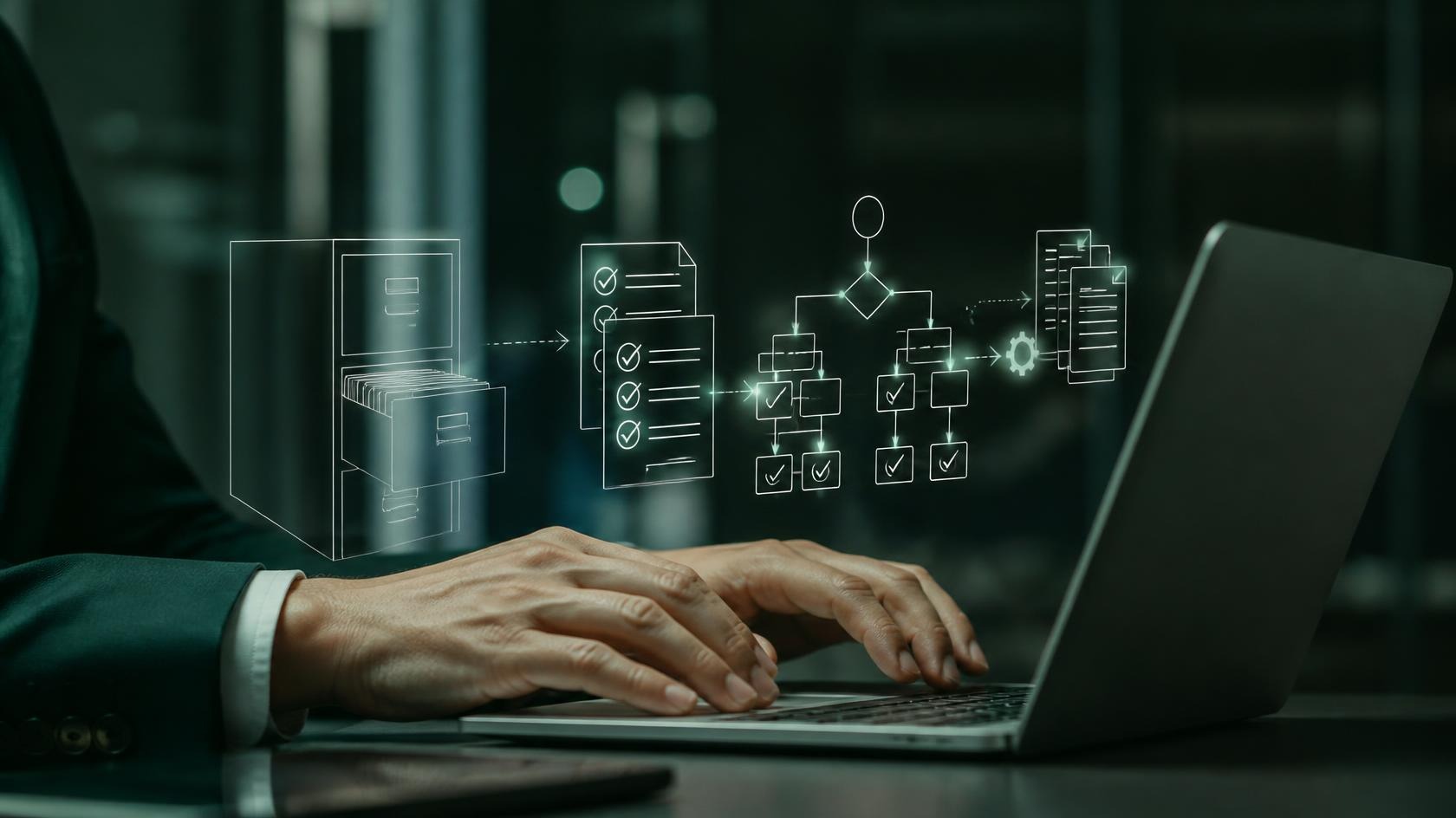
For the last decade, GRC software has been a very expensive filing cabinet. It stores the risk and control matrix, tracks who owes which evidence, and records that a test was done. It has never done the test.
That was fine when only people could do the work. It stops being fine the moment software can. In audit, that moment is now, and it changes where the value in this market sits.
The old moat: owning the record
GRC platforms won by becoming the system of record. Once your controls, RCMs, test history and audit trail lived in one tool, leaving it was painful. Switching meant migrating years of data and retraining every control owner.
But look at where the actual work happens. Walkthroughs happen in meetings. Evidence lives in ERPs, ticketing systems and inboxes. Testing happens in spreadsheets, done by staff auditors or a co-sourcing firm. The GRC tool sees the work only after it is finished, when someone uploads the workpaper and clicks “complete.”
The system of record holds the outcome of the work, not the work itself. That gap is where the moat is about to move.
What changes when AI does the work
AI agents can now do real audit fieldwork. They select samples, pull evidence from source systems, check completeness and accuracy, test the control, flag exceptions and draft the workpaper.
Once the work happens inside the software, the record becomes a by-product. Every step is captured as it is done, with the evidence source, the reasoning and the reviewer’s sign-off attached. You no longer need a separate tool to store the result of work done somewhere else.
That flips the buying question. It used to be “where do we track our audit program?” Now it is “who, or what, actually does the testing?” A platform that only tracks will lose to one that executes and records at the same time.
The case: one SOX control, two ways
Take a typical ITGC, such as quarterly user access review, and follow it through a test cycle. At Complify we see this pattern across the 50+ public companies we work with.
The result is up to 70% less manual SOX testing effort. Testing that was outsourced can come back in-house, and the team covers more controls with the same headcount.
The bigger shift is structural. In the left column, the GRC tool is optional; you could keep the same files in a shared drive. In the right column, the platform is the work. You can’t rip it out without losing the auditors.
The same shift, across the whole GRC lifecycle
SOX testing is the clearest case, but the pattern repeats in every part of GRC. In each area below, the left column is what a system of record does: it tracks the work. The right column is what an AI audit team does: it performs the work and leaves the record behind as a by-product.
1. SOX compliance and control automation
Result: up to 70% less manual SOX testing effort, more consistent testing, and outsourced work brought back in-house.
2. Enterprise risk management
Result: a risk picture that stays current, and audit attention that follows real exposure instead of last year’s plan.
3. Internal audit management
Result: the full audit lifecycle in one place, with AI doing the fieldwork and monitoring that used to wait for the next cycle.
4. Issue management and remediation
Result: issues close faster, nobody spends their week chasing owners, and every fix is proven, not just marked done.
5. Executive and Audit Committee reporting
Result: the board sees what is true today, and your team stops spending the week before every meeting building slides.
6. Governance, integrations and audit trail
Result: AI that auditors and regulators can trust, because every step it takes is visible, governed and approved.
Where the new moat lives
The moat moves from owning the data to owning the workflow. Three things make that workflow hard to copy:
- Execution depth. Knowing how a real auditor tests a three-way match, an IPE report or a change-management control, down to the exceptions that matter. Generic AI does not know this; audit-specific agents learn it control by control.
- The judgment loop. AI does the legwork, and humans approve risk ratings, scope, deficiencies and final conclusions. Every approval and correction makes the next test better. That feedback is something a filing cabinet never collects.
- One connected chain. Risks link to controls, controls to tests, tests to findings, findings to remediation and board reporting. When AI works across that whole chain, nothing gets re-keyed between tools.
Data can be exported in an afternoon. A workflow your team runs every quarter, with AI auditors trained on your methodology, cannot.
From point-in-time to always-on
The system-of-record model has a hidden assumption: audit is a calendar event. You test a sample once a quarter or once a year, file the workpaper, and hope nothing broke in between.
That assumption exists only because testing is expensive when people do it. When AI auditors do the work, the cost of running a test again drops close to zero. So you stop sampling a moment and start watching the control.
Continuous monitoring means recurring control checks run automatically between audit cycles. A user who kept access after leaving the company, an unapproved change pushed to production, a journal entry posted outside policy: these get flagged within days, not discovered months later at year-end.
This is where the record truly stops being the product. A system of record can only show you what was true the last time someone tested. A platform that executes continuously shows you what is true now. That is a different promise to the audit committee, and one a filing cabinet cannot make.
What this means for audit and SOX leaders
If you are evaluating GRC software in the next twelve months, change the questions you ask:
- Not “Can it store our RCM?” but “Can it test our controls?”
- Not “Does it track evidence requests?” but “Does it collect and validate the evidence?”
- Not “Can it schedule our quarterly tests?” but “Can it monitor our controls between tests?”
- Not “Does it have dashboards?” but “How much of the work behind the dashboard did a person still have to do?”
- Not “Is it AI-enabled?” but “Where exactly do my auditors approve, and is every AI step logged?”
The teams that switch early will run SOX and internal audit with the same headcount and far more coverage. The teams that wait will keep paying for a filing cabinet, and for the people who fill it.
From managing compliance to executing it
Systems of record will not disappear overnight. They will fade into the background, the way filing cabinets did once the work moved onto computers. The record will still exist. It will simply come free with the work.
That is why we built Complify as the first AI-native GRC platform with a built-in AI audit team. Our AI auditors don’t just track SOX, risk and internal audit work. They do it, keep doing it between audit cycles, and hand every material call back to your team.
For the teams we work with, that means:
- Up to 70% less manual SOX testing effort
- Lower audit and co-sourcing costs, with more testing brought in-house
- More audit coverage without scaling headcount
- Higher quality and consistency, through standardized testing, automated documentation and independent AI review
- Full visibility and control, with real-time reporting and humans approving every material call
- Risk, compliance and internal audit unified on one AI-native platform
But the real return isn’t on a spreadsheet. It’s the weeks no longer spent chasing evidence. The nights before the audit committee no longer spent building slides. The quarter-end scramble to test a sample and hope it holds, gone. That time goes back to the people who became auditors to exercise judgment, not to feed a filing cabinet.
For years, GRC software asked auditors to serve it. The next generation works alongside them.
The moat was never the record. It was always the work. And for the first time, software can do it.